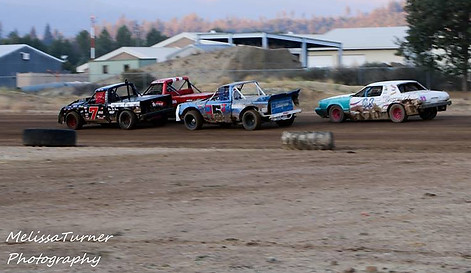
Mini Cars/Truck Rules - 2019
Mountain Valley Raceway
2019 Mini Car/Truck Rules
A. Safety Equipment/Gear
1. Seats
1-A Aluminum high back seats only. No homemade aluminum, plastic or fiberglass allowed.
1-B Seats must be mounted to the roll cage only, not on the floor pans. Seat must be bolted in using at least four (4) 3/8” minimum hardened bolts at a minimum of four (4) points to the roll cage or frame structure.
1-C Upholstery and padding suggested.
2. Seat Belts
2-A 5 pt. quick release restraint system three (3) years or newer required. Faded or worn belts must be replaced no matter the age.
2-B Quick release lap belt, shoulder harness and crotch belt must be no less than 3” wide.
2-C All seatbelt components must be mounted to the roll cage separate from the seat with a minimum of eight (8) 1/2” grade bolts. Belts must be mounted correctly. Belts must come from behind driver/passenger. Mounting position is important. Shoulder belts should be mounted 4” below shoulders and lap belts should be mounted the same width of the driver/passenger belts. The belts must be worn at all times while the car is on the track. Only exception is while picking up your trophy.
3. Window Nets
3-A Driver and passenger (if equipped) side window nets required. Window nets must be equipped with quick releases. The nets must be a minimum standard 16x20” ribbon or mesh style and must be mounted to the roll cage accessible by the driver and safety crew. Window nets must be in good condition, be three (3) years old or newer, and must detach from the top.
4. Roll Bar Padding
1-A Roll bar padding must be fire retardant. No foam pipe insulation and no pool noodle foam. Roll bar padding must be on all roll bars around driver/passenger head area. It must also be installed where driver/passenger can reach. By you legs is also suggested.
5. Fire Extinguishers
5-A If no on-board fire suppression system has been installed, then one (1) minimum 2.5 pound dry powder fire extinguisher must be mounted within the drivers’ reach in an approved quick release mounted bracket.
5-B Must have a minimum 2.5 pound (preferably greater) fire extinguisher in every pit. Preference would be one (1) per race car. The fire extinguishers must be maintained in a fully charged and up-to-date condition.
6. Helmets
6-A DOT approved full face helmets with face shields are mandatory. Valid SA 2010 allowed. SA 2015 dating is preferred.
6-B Buckle and strap must not be worn or frayed. Helmet must be worn and fastened at all times while on the track. The only exception is while picking up trophies.
6-C Neck collars are highly recommended.
7. Suit
7-A One piece or two piece racing suits are allowed. Suits must be in good condition with no holes or tears. Every driver/passenger must wear a fire resistant racing suit. Single layer suits are allowed.
7-B Nomex style socks, underwear, hood and shoes are recommended.
8. Gloves
8-A Racing gloves are recommended.
9. Shoes
9-A Racing shoes are recommended.
B. Chassis
1. Any 1955 or newer American-made passenger car is allowed. Vehicles not allowed are 4-wheel drives, sports cars and/or convertibles. Station wagons are allowed.
2. Unibody cars must have 2” x 4” minimum sub-frame connectors. Material .095 minimum.
3. No intermixing of body and frame parts. (manufacturer to manufacturer only). Swapping engines is allowed. Engine must be GM to GM or Ford to Ford, etc.
4. Vehicles must be de-chromed and all glass and flammable material must be removed except gauges and bumpers. No mirrors are permitted.
C. Body
1. Body panels must be stock, metal only. No aluminum or plastic except on noses and/or tails.
2. Body must be securely mounted to the frame from the rear of the driver forward.
3. Firewall must be stock or 18-gauge sheet metal to replace damaged firewall in stock location and to cover all holes for fire protection to drivers’ compartment.
4. Gutting panels are limited to hood, trunk lid, roof, doors, fenders and trunk area past the rear axle.
5. Floor pans must be stock or 18-gauge minimum from the rear of the drivers and passenger seat forward. Must be welded or bolted. If welded, welds must be 3” long and 7” between each weld minimum. Full weld is preferred.
6. Outside iron rails, nerf bars, rub rails are allowed. Maximum of 1-1/2” x .095 tubing or 1” x 2” rectangle tubing. Nor more than a 1” gap between the rub rail and body skins. Maximum length outside from from fire wall to rear firewall/rear compartment divide. Ends must be tapered and capped.
7. Fenders may be cut to give 4” clearance above the tires. No protruding edges allowed.
8. Hoods and trunk lids must be secured at all four (4) corners. Hood must be in place to start a race. No hood - No start.
9. No plexiglass is allowed on car anywhere.
10. Car must have a minimum of half the windshield area in front of the driver and full windshield, if passenger, covered. There must be a minimum of three (3) posts or straps located in front of driver (and passenger). Posts/straps must be securely attached to the body of cage. Must be made of a minimum of 1/2” tubing or 1/8” x 1” flat bar. (1/2” rebar is preferred). Wire mesh/expanded metal of 1/4” to 3/4” squares must cover drivers’ side (and passenger side) and be completely and securely attached.
D. Numbers
1. Cars must have clear and contrasting numbers on both doors and on the roof. Minimum size of numbers is 18” tall and 2” wide on the doors and 24” tall and 3” wide on the roof. If a car has a front and/or rear nose cover, at least one 10” tall and 1” wide number. REMEMBER, points will only be scored if the scorekeeper can clearly see your numbers from the top of the grandstands. A 3” drivers’ name on the roof is optional but preferred.
E. On/Off Switches
1. Cars must be equipped with an on/off switch for starting the car and clearly market “on/off” and be easily reached by driver and safety crew.
2. Car must be equipped with a battery on/off switch clearly marked “battery on/off” and be easily reached by driver and safety crew.
3. Car must be equipped with a fuel shut off if an electric fuel pump is used. It must be clearly marked “fuel on/off” and be easily reached by driver and safety crew.
F. Weight
1. All added weight must be painted white with the car number marked on each piece. Weight must be securely fastened. Minimum of 1/2” hardened bolts must be used or welded on. Weights must remain inside the bodies on not on bumpers. Maximum of 25 lbs. per mount. Multiple mounts are allowed.
G. Towing
1. Tow points on the car must be clearly marked as tow areas. Tow point must be secure enough to tow the car. Loops of chain are allowed.
H. Roll Cage
1. Roll cage shall be a full cage type. Minimum of 6-point cage inside. Mild steel .095 wall minimum by 1-1/2” or 1-3/4” (preferred). A full loop from frame over the driver and/passenger must be attached to a full loop surrounding roof line. Cage must be within 3” of top and 6” of sides.
2. Cage must be welded and/or bolted to the frame. If bolted, must use 1/2” hardened bolts minimum. Cage may not be welded to the floor pan. If bolted to the floor pan there must be a minimum of two (2) 6” x 1/8” square plates with four (4) bolts on each down bar. (One (1) plate on each side of the floor plate). Minimum of four (4) down bars.
3. Cage to be above driver/passenger helmet by 2” minimum clearance.
4. All “T” intersections of cage must be gusseted and welded.
5. Inner cage must have a minimum of four (4) horizontal bars on the drivers’ door within 3” of door. Minimum of three (3) uprights, evenly spaced between each horizontal bar to protect drivers’ hips and legs. A minimum of 1/8” plate attached to driver door bars to cover all four (4) horizontal bars.
6. If set up for a passenger, cage must be built the same as drivers’ side. If no passenger set up, only three (3) horizontal bars and no plating is needed.
7. There will be two (2) bars angled from the top of inner cage towards the rear end. These can extend past the rear axle to frame rails. Crossed or “X” pattern preferred.
8. Front hoops will be allowed inside body, behind bumpers to protect the radiator. Cage may go through the engine compartment. Radiators must be in stock location.
9. Drivers may be asked to drill a 1/4” hole on the cage somewhere for inspection.
10 All welds must be neat and complete. Popcorn welds will not be accepted.
11. Roll bar padding must be fire resistant. No pool noodles or pipe insulation from a hardware store. Padding must be installed anywhere driver/passenger is able to reach and completely around head/helmet areas.
I. Vehicle Description
Mini Trucks
1. Any American or foreign made stock Mini Truck. No 4 x 4’s, no rear engines or rotary engines.
2. Frames cannot be altered from stock from stock shape and/or configuration. Chassis length will be measured wheel-to-wheel. Trucks MUST look like trucks and must be a truck chassis.
Mini Cars
1. Any American or foreign production economy sedan, coupe or station wagon originally equipped with a 4-cylinder engine. No 4-wheel drive, rear or mid-engine cars. Maximum wheelbase to be 100.5 inches. Front wheel drive cars are permitted.
1. Vehicles must be completely stripped. No factory interior, no chrome or glass.
2. Stock OEM chassis permitted. OEM chassis may be reinforced with steel tubing subject to tech approval.
J. Engine
1. 4-cylinder only. Maximum weight of 2200 lbs. with driver and fluids.
2. Water-cooled inline 4-cylinder production engines of 2600 cc. or less. No rotary engines allowed.
3. No porting and/or polishing allowed.
4. OEM heads and blocks only.
5. Single cam, two (2) valves per cylinder only. No dual cam shafts allowed.
6. Adjustable cam devices are permitted.
7. No more than 200 lbs. compression.
8. No exotic metals allowed.
9. Headers are allowed. Must have stock intake.
10. Cockpit exhaust is permitted if shielded from driver and exits behind the driver using approved cockpit sheet metal. No exhaust may invade driver’s side of the cockpit. No exhaust through body panels or fenders.
11. Stock or aftermarket pistons may be used.
12. Connecting rods must be ferrous.
13. Motor mounts and engine must be in stock location. Engine makes must match the make of the frame and body.
K. Carburetor
Trucks: May run any stock 2-barrel carburetor on any engine. No injection or throttle bodies allowed. Maximum of 500 cfm. No turbos or rotarys.
Cars: Must use a single 2-barrel downdraft carburetor that flows less than 501 cfm.
1. Any 2-barrel stock carburetor allowed. Stock 4412 is the maximum allowed.
2. Carburetor adapter will not exceed 2-inches (1-inch) in height from the stock location. Blending adapter to manifold is permitted. Blending is limited to 1.5 inches down from stock carburetor base.
3. Turbo charging, fuel injection or supercharging shall not be permitted. Vehicles originally equipped with fuel injection must be adapted to run a carburetor.
L. Ignition
1. Ignition will be stock. No magnetos.
2. Distributors may be locked out for an advance system. Aftermarket coils permitted.
M. Radiators
1. Any radiator may be used, but must be mounted in front of the engine.
2. Radiator protectors are permitted.
3. Anti-freeze is not permitted.
N. Body
1. Trucks must have full bodies including hood, fenders and bumpers. All rubber frame-to-body mounts must be removed.
2. Vehicles must be completely stripped. No factory interior, no chrome, no glass.
3. Truck bed must be enclosed with a cover, mounted flat from back of cab to tailgate with 30 gauge minimum thickness steel or comparable strength aluminum, securely welded, bolted or pop riveted to the bed.
4. Truck bodies must be steel and remain strictly stock. The original cowl and complete and floorboards must remain in tact with all unnecessary holes covered.
5. Cars: Stock or aftermarket bodies are permitted.
6. Minimum 22 gauge steel or aluminum body, hood and roof panels. No fiberglass bodies.
7. Body must be firmly attached to secure mounting points.
8. Aftermarket nosepiece of plastic, fiberglass or rubberized materials are permitted.
9. Driver’s compartment must be safely sealed from the engine bay, fuel cell and exhaust.
10. Front OEM firewall and floorboard must be used and remain in stock locations.
11. Right side of driver’s compartment may be boxed off to allow the exhaust system in this area.
12. Body may be altered in the truck area for the fuel tank. Fuel tank must be behind the rear axle. Fuel cell is required.
13. All body panels and fender wells may be cut for tire clearance. No sharp edges.
14. Rear deck lid spoiler is permitted. Limited to 6-inches measured from the top of the deck lid.
15. Inner front fender wells may be removed.
16. No rear-view mirrors allowed. No 2-way radios allowed.
17. Doors must be welded or bolted shut at all times. If bolted they must also be chained. Hoods are to be securely fastened.
18. Bumpers may be replaced by any bumper no wider than the outside of the tire, front and rear. No sharp edges - No Exceptions. Strapped to the body or rounded ends. No sharp or blunt ends.
19. Front and rear bumpers are mandatory and must be in stock location. May be round or square .095 tubing replacements. No black pipe allowed. Front bumper not to extend out past center to center of tires. All bumper ends must be smooth, capped and turned back with NO SHARP EDGES. Officials reserve the right to approve or reject any bumper. All bumpers must allow tow truck strap access, i.e.. welded hoop for tow hook.
20. Head-light and tail-light openings must be covered.
21. A metal screen must cover the windshield opening completely, minimum 1/4-inch to a maximum 1/2-inch mesh wire. Must have a minimum of three (3) bars on the Driver’s side using at least 3/4-inch rebar or 1/4 x 1-inch flat bar securely fastened.
22. Vehicle numbers must be a minimum of 18 x 2-inches high and placed on both doors and the top of the vehicle. Must be legible and of a contrasting color for visibility. Body panels will be painted and numbered to the satisfaction of race officials. 10-inch numbers on front and rear if enclosed.
O. Steering
1. All components must be steel, unaltered OEM location and match frame. OEM steering column may be replaced with steel knuckles and steel steering shafts (collapsible recommended). Quick release is required. No center steering. Steering quickener is permitted.
2. All vehicles must have a metal strap or chain under the drive shaft. The strap must be located within 6-inches of the front universal joint. Drive shaft must be painted white and have the car number on it.
P. Electrical
1. Point-type OEM ignition or electronic ignition. No magnetos.
2. Battery must be securely mounted behind the driver and secured in a metal or plastic container. Preferred location is in the trunk/bed area with the fuel cell.
3. Passenger car batteries are allowed.
4. All vehicles must start under their own power and be running when leaving the pit area for each race.
5. A battery shut-off switch mounted through the trunk/bed cover directly behind the driver is mandatory on all vehicles. It must be clearly labeled “On and Off”.
Q. Fuel and Fuel Cell
1. Automotive gasoline or racing fuel is permitted. No methanol, alcohol or additives are allowed.
2. Fuel cells are mandatory, no larger than 16-gallon capacity. Must be rigidly mounted in the trunk/bed area. Must be strapped four (4) ways with metal straps 1-inch wide by 1/8-inch thick. No outside fillers. Track Officials must approve all fuel cells. Stock tanks must be removed. If the fuel cell is not in a steel can, there must be a 1/8-inch minimum steel plate protecting the back of the cell.
3. Electric fuel pumps are permitted. May not be glass or cockpit mounted. Kill switch required on Driver’s side, painted white.
4. A positive locking filler cap must be used. Breather vents must be designed so that fuel will not escape if the vehicle is upside down.
5. A rear firewall is required to protect the Driver from fuel leaks. It must be completely covered and no holes.
6. The fuel cell must be fuel tight and have a functional roll-over valve.
7. There must be a 1/4 turn shut-off valve on the fuel line to the right of the driver accessible by the driver and safety crew. It must be clearly labeled “On and Off”. Must be in plain sight and easily operated with one hand.
R. Transmission
1. Transmission must have a reverse gear and all forward gears operable, either automatic or manual. Transmission must be in the stock position.
2. All clutches and flywheels must be OEM.
S. Suspension
1. Front and rear suspension must be of the original type with no modifications. One (1) shock per wheel. The original shocks may be replaced with heavy duty shocks. Stock Non-Adjustable replacement shocks, struts and springs are permitted.
2. Must use OEM lower control arms and spindles on the front suspension. Tubed upper A-Arms are permitted.
3. No coil-overs. Racing type shocks are permitted. Front shocks must remain in the stock location, but can be aftermarket.
4. No weight-jacks. No cockpit adjustable weight jacking devices allowed.
5. Suspension mounting points may be altered but suspension must mount in the stock manner for the chassis being used.
6. No Z-Link or birdcages.
T. Roll Cage
1. Shall be at least a 6-point cage with four (4) uprights connected at the top.
2. Driver’s side roll bars must curve out to 1-inch from the skins. Passenger side may be straight across. Horizontal bars have a minimum of three (3) upright braces between each row of the door bars. An additional bar must be welded to the top (roof area) of the roll cage running from left to right, front to rear diagonally. A horizontal bar must be installed between the front two (2) vertical bars at dash height on all vehicles.
3. Main cage must be constructed of 1-1/2 inch diameter tube with .095 wall minimum. NO BLACK IRON OR GALVANIZED PIPE.
4. Full cage roll bars are required with full loop frame over the driver. Cage will be within three (3) inches of the roof of the vehicle.
5. Roll cage must be secured to the frame or floor pain on uni-body vehicles by welding solidly around each upright bar or by welding each upright bar solidly to a 6 x 6 by 1/4-inch plate then welding or bolting this plate, using no less than 1/2-inch hardened bolts, solidly to the floor. Plates shall be welded to each side of the floor.
6. A minimum of three (3) horizontal door bars on driver’s side of at least 1-1/2-inch OD tubing located at approximately seat height, running from the front roll bar to the rear roll bar evenly from the bottom of the seat to the top of shoulder. A minimum of two (2) on the passenger side will be required on the inside.
7. Gusseting on all bar junctions will be required.
8. Roll bar padding is mandatory where driver can come in contact with the cage. All roll bar padding in the driver’s compartment must be fire retardant. No pipe insulation or pool noodles.
9. Driver’s door bars plated minimum 1/8-inch steel is mandatory.
U. Drive Train and Brakes
1. Single disk, stock appearing clutch only. No ram couplers, etc. Aftermarket clutch is permitted. No direct drive. Automatic transmissions must have functional OEM torque converters.
2. Stock, lightened or aftermarket flywheel is permitted. Must be stock diameter for block used. No aluminum flywheels.
3. A 180 degree scatter shield must be installed underneath or over the floorboard using a minimum 1/8-inch steel plating to protect the driver’s legs.
4. Drive shaft must be painted white. No aluminum drive shafts. A drive shaft safety hoop will be required from 4-inches to 6-inches behind the front joint. Hoop must be 1/4-inch thick and 1-1/2 inch wide steel strap or chain.
5. Rear-ends must be stock type only. Make and model rear-end may be changed.
6. No aftermarket or quick-change rear-ends are permitted.
7. Welded or otherwise locked rear-ends shall be permitted.
8. Must have working brakes on at least three (3) wheels. No cockpit adjustable proportioning valves. Disc brakes are permitted. Calipers and rotors must be OEM. Locking rear-end does not constitute one brake. No cockpit adjustable devices will be allowed.
9. In cockpit steering may be modified to suit driver’s taste, but must be on the left side of the cockpit. No center steering.
V. Wheels and Tires
1. Tire width not to exceed eight (8) inches.
2. Any type steel or aluminum aftermarket wheel with a maximum width of 8-inches. 15-inch maximum wheel diameter (16-inches if factory standard). Wheel spacers not to exceed 1-inch. Any offset is allowed.
3. Bead lock is permitted on the right rear only.
4. Stock wheels allowed but right side wheels MUST HAVE REINFORCED CENTERS.
5. Minimum of 5/8-inch wheel studs and lug nuts. 1-inch is suggested.
6. No sipping or cross grooving allowed.
7. No snow tires, no spiked or studded snow tires are permitted.
8. DOT radial tires or Hoosier Oval Track DOT Dirt/American Racer Passenger Performance tires (medium compound or harder).